Showing posts with label reading. Show all posts

new beginnings

At the end of last year, I decided to make a change.  A big change.  I decided to leave the school where I have worked for the past 6 years, the school that gave me my first teaching job.  It was a wonderful school with amazing teachers, but, as my mentor put it, I was given wings and now it's time to fly.  

The start of this school year marked a new beginning as well as fresh challenges.  I had to learn a new culture, recreate a new classroom, and meet  many  MANY new faces.  At first it was scary...you never know if the grass is going to be greener.  But as hectic as the last six weeks have been, it has been wonderful!  My team is awesome, the kids are great (but I already knew that), and the administration and parents are soooo supportive.


One of the most exciting new challenges I have this year is implementing the Daily 5 into my daily routines.  I have been reading about the Daily 5 from many of you bloggers out there, and so I'm very excited to have the chance to try it out myself! 


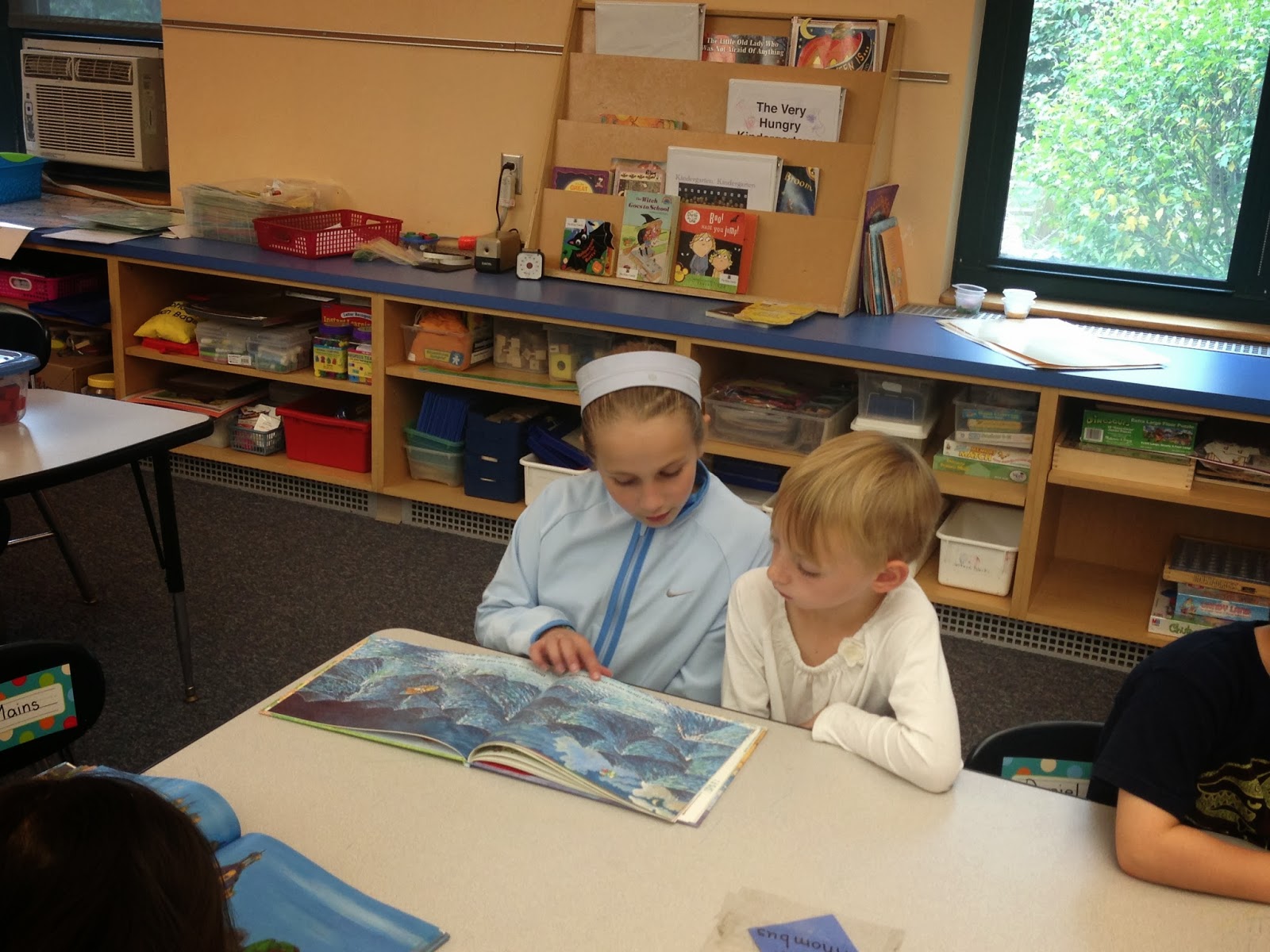
We have been working hard on Read to Someone for the last couple weeks.  Yesterday, my class teamed up with Miss G's kindergarteners to introduce our weekly Reading Buddies.  


During Library, each of my students picked out a picture book they felt their kindergarten Reading Buddy would enjoy.  Then they practiced reading aloud during Daily 5 this week.


My 5th graders were soooo excited to meet their buddies.  As the oldest members of the school, they really stepped up as role models: greeting their buddies and making them feel comfortable, and practicing good expression when reading.  Many of them also found they had a lot in common with their buddy!


I hope everyone has a great long weekend!  And don't forget to head on over to Principal Principles and share your blog!  I'd love to check out what's going on in your classroom!


Follow my blog with Bloglovin

math mentor texts


Happy Mother's Day to all the mothers out there!  I just came home from brunch with my mother-in-law and am now relaxing before I go back out for a late lunch with my stepmother.  In the meantime, I'm linking up with Collaboration Cuties to share some of the mentor texts I use in my math classes.


The first mentor text I'd like to share is Math Curse by Jon Scieszka and Lane Smith.  


I always read this book in September as part of our "Let's get excited for math" lesson.  Afterward, I challenge the kids to try to solve all of the problems and always get a couple who take me up on it.  It's fun to watch them stick with it when the math gets really high level, but they are so proud of themselves when they finish.


The next is Multiplying Menace, The Revenge of Rumpelstiltskin by Pam Calvert.


I love to read this book to introduce our multiplication unit.  It has a great story line and the kids like to call out the answers as we read.


And finally, The Multiplying Menace Divides also by Pam Calvert.


Since our division unit comes directly after our multiplication unit, the kids are always excited to read this sequel.  The story lines are similar enough that they can enjoy the familiarity between the two, yet different enough to keep them entertained.


Can't wait to check out what everyone else uses and get some great ideas for next year!  
Have a great Sunday everyone!


Follow my blog with Bloglovin

where babies come from


Recently, one of my book groups began reading Out of the Dust by Karen Hesse.


This book is about a 13 year-old girl and the hardships she faces while living in the Dustbowl period during the Great Depression.  I picked this book because of its rich, descriptive language and also because its structure is free verse poetry and reads like journal entries.

To give the group some background information, we read a National Geographic article that explained what lead to the Great Depression and the dust storms. 


When we opened the book, one of my students noticed that the date on the first page said 1920.  Immediately, he asked, "How can this book be set in the Great Depression if the date says 1920?" 
So we began to read together the first page, where it describes the main character being born "on the swept floorboards of the kitchen because that's where Daddy said it would be best."  All I am intending is for the group to recognize that this is a sort of prologue since the next section skips to 1932.
The same student says, "I don't understand how women could have babies back then and live if they weren't in a hospital.  How do they get the baby out of the stomach without surgery?"
I responded, "Well, some women have surgery and the baby is taken out of the stomach and some women don't."  (moving on.)
We continue to read and then the boy stops and says, "But wait.  If the baby doesn't come out of the stomach, where does it come from?"  He thinks for a minute, while I stammer a couple "ums" and try to change the subject.  
Finally, he looks back at the text (nice use of a reading skill!) and says, "I see here it says that the mom was crouching.  Wait a minute," (thinks) "Does the baby come out of her butt?"  
At that exact moment, I look across the table at another student.  He is shaking his head and repeatedly whispering, "That's not where babies come from.  That's not where babies come from."
I can feel my face burning, and all I can think is "I did NOT anticipate this conversation when I planned this lesson!"  Finally, I manage to blurt out "I think you should ask your mom where they come from when you get home.  Let's move on."

social studies mentor text


Today I am linking up with Collaboration Cuties to share a Social Studies mentor text.  


Mayflower 1620 is a book that highlights what life was really like for the Pilgrims.  It is written in collaboration with researchers from Plimoth Plantation and National Geographic.  


The kids love to read this book because it shows both the Pilgrims' and Native Americans' sides to the story. We stop at certain points and debate from each group's point of view.  They learn how the different cultures interpreted the other's actions according to their own beliefs and the tension it created.  The book also has recipes of dishes that were served at the first Thanksgiving.  Some are similar to what we eat today while some are very different!

In addition to reading this book, we watch "The Mayflower Voyagers (This is America Charlie Brown)," which is entertaining but also pretty historically accurate!


Can't wait to see what everyone else uses for mentor texts and get some great ideas!

bookmark monsters

Last week, we made bookmark monsters to get excited about our reading. I waited to introduce the activity until Friday afternoon because everyone knows (or can imagine) what 10 year-olds are like at 2pm on Fridays.

We started by folding construction paper to make the corner. Then each student customized theirs to make them unique. Here are a couple.

fractions in quilting

Several factors led to the making of this lesson.  1) Friday was Community Reading Day, 2) It was the end of a very long testing week (we NEEDED a fun project) and 3) my IA is getting her certification and needed practice creating and teaching lessons.  Therefore, my IA, Mrs. M, planned this great lesson that integrates quilting and the math behind it.  

First, while the kids were at Library, we draped the room in quilts that Mrs. M's mom made.  


These quilts are amazing, and the kids were so excited to see them.  They got a chance to look at each one, and Mrs. M taught them the history behind quilting in America.  She also discussed the different patterns, color choices, and materials that are used.  Then we went to the library where our community member read A Cloak for the Dreamer to celebrate Community Reading Day.  


This book lead to a discussion about which shapes can be used to make quilts and which ones cannot.  (BTW, this book is great for a lesson on tesselations!)  Then Mrs. M introduced the activity: each student was given a tangram template, scrapbook paper, scissors, and glue and told to create an original quilt square.  They were allowed to alter their tangram shapes as long as they kept to the shape of the square.   


It was interesting to watch how the kids problem solved throughout the activity.  This one planned hers out first and even used numbers to label the different patterns.  That's my girl!


The kids took time to check out each other's squares to get ideas, but each one ended up completely original.


After the kids finished their quilt squares, they needed to figure out what fraction of the square each shape represented.  This ended up being a real challenge: they needed to combine their skills of adding, multiplying, and dividing fractions.  It was refreshing to see them rise to the occasion (and without any complaints I might add).


When everyone completed their project, we put them all together to make our class quilt.


So amazing!  Thanks Mrs. M for putting together a great lesson!


library dogs

Today I came across Library Dogs, a website that promotes using therapy dogs to help children improve their reading skills.  Check out some pictures from their website.
Sunny is paying careful attention.

Maggie loves listening to Arthur's adventures.

This student has learned how relaxing a good book can be.


Sunny enjoys a Star Wars book.

What an awesome idea!  I know my students would die for the chance to read to a dog.  The great part about this program is that it gets ALL kids excited about reading, but especially the ones who struggle with fluency.  Reading to a dog relieves all the stress of reading out loud because dogs don't judge.  They don't care if you read below grade level, or if you stumble on a word.  They just want to spend time with you.

Unfortunately, these Library Dogs aren't as widespread as I had hoped.  The closest trainer is almost 90 miles away!  But there's hope.  If you own a dog, you can do this at home.

Click here to see if a R.E.A.D. (Reading Education Assistance Dogs) program is in your area.